Security Engineering: Mindset, Skills, and Roadmap
A practitioner's framework for developing offensive security expertise through systematic thinking, architectural understanding, and disciplined methodology.
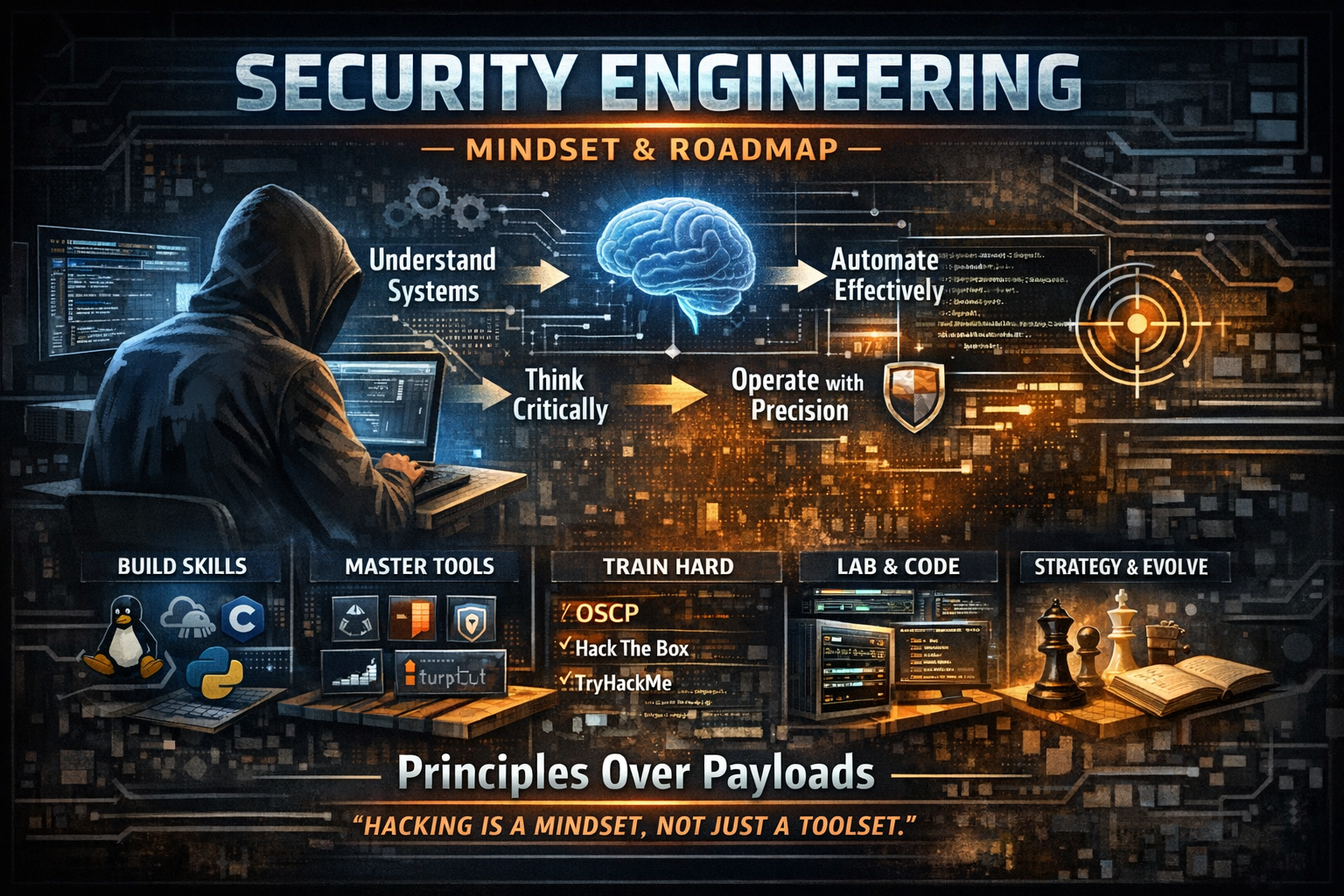
“You don’t become a hacker by learning exploits. You become one by understanding systems, deeply.”
Most people approach security by collecting tools and chasing exploits. That approach does not scale.
Professional offensive work is built on understanding how systems are constructed, how they fail, and how to test them in a controlled, repeatable way.
In real environments:
- Reliability matters more than cleverness.
- Consistent process matters more than tricks.
Security work is not about memorizing hacks or flashy exploits. It’s about understanding systems well enough to predict how they fail, automating intelligently, and operating with precision.
Tools change every year. Principles do not.
This is the structure I use to train, operate, and deliver real results.
Phase 0: Develop the Hacker Mindset
Curiosity over Skill obsess over why, not just how. Study systems deeply.
Precision over Speed Rushing leads to mistakes. Operate with accuracy and patience.
Failure is Part of the Process Embrace being stuck, it signals growth.
Learn Before Automating Don’t rely on tools you don’t understand. Study the logic first.
Think Long-Term Track your progress, build knowledge systems, and share insights.
Hacking is about thinking. Tools evolve, but mindset endures.
Phase 1: Build a Strong Technical Foundation
1. Systems Knowledge
Before exploiting anything, understand the environment.
- Linux: Debian, Arch, file systems, permissions, services, processes, logs, scheduling
- Windows: Registry, services, tokens, users, Active Directory basics
- Networking: TCP/IP, DNS, HTTP, ARP, ICMP
If you cannot explain how a system works, you cannot compromise it reliably.
Add these to your daily warm-up:
1
2
3
man bash
man 7 signal
curl ifconfig.me
2. Programming Essentials
Manual work does not scale. Script everything.
Choose two:
Python– scripting, exploit developmentBash– automation, shell interactionC– memory corruption, low-level debuggingPowerShell– Windows scripting, post-exploitation
Goal: Own your workflow. Read, modify, or rebuild scripts immediately. Build tools that solve exact problems, they become your advantage.
💡 Knowing How to script ? is more valuable than memorizing syntax.
Phase 2: Master the Core Tools (Manually)
| Category | Tools |
|---|---|
| Reconnaissance | nmap, ffuf, subfinder, crt.sh, amass |
| Enumeration | LinPEAS, winPEAS, enum4linux, BloodHound |
| Exploitation | Burp Suite, sqlmap, Metasploit, custom scripts |
| Privilege Escalation | GTFOBins, LOLBAS, Windows Exploit Suggester |
| Post-Exploitation | socat, chisel, netcat, PowerView, Rubeus |
| OSINT | theHarvester, Spiderfoot, GHunt, twint |
Don’t just run tools! study their output, inspect the source, and rebuild them yourself.
Phase 3: Train Like a Hacker
Practice Platforms
Recommended Learning Paths
- OSCP (Offensive Security Certified Professional)
- PNPT (Practical Network Penetration Tester)
- TCM Academy
- PentesterLab
- HackTricks
Don’t jump from tool to tool. Go deep. Master the process.
Phase 4: Build Your Arsenal
Structure your GitHub:
reverse-shells/upload-bypasses/priv-esc-checks/automation-scripts/one-liners.txtwriteups/
Basic recon automation:
1
2
3
#!/bin/bash
nmap -p- -sC -sV -oA scan $1
ffuf -w /usr/share/seclists/Discovery/Web-Content/common.txt -u http://$1/FUZZ -t 50
Phase 5: Think Like a Hacker
Ask these questions constantly:
- What assumptions is the developer making?
- How is this system trusting input?
- Where does the application fail to validate or sanitize?
- What if I go beyond the intended use?
“Real hacking starts in the mind. It’s how you think, not what you copy.”
Phase 6: Operate Like a Professional
Typical Workflow
1
2
3
4
5
6
1. Passive Recon — Subdomains, Git leaks, metadata, email discovery
2. Active Recon — Ports, services, stack fingerprinting
3. Exploitation — CVEs, injection, logic flaws, credential reuse
4. PrivEsc — SUID binaries, misconfigurations, credentials, tokens
5. Post-Ex — Lateral movement, data exfiltration, persistence
6. Reporting — Clean writeups, replayable steps, proof of impact
Enumeration is 90% of the process. The better you map the target, the better your success rate.
Phase 7: Think Long-Term: Strategy & Evolution
Once you’ve got your hands dirty, start looking beyond one-off hacks. Real growth happens when you build systems of knowledge and improvement.
- Create your own lab: VirtualBox, VMware, Proxmox, simulated networks
- Red/Blue Team balance: Learn both sides to become a better hacker
- Track your journey: Use Obsidian, Notion, or a GitHub Wiki
- Give back: Blog, build tools, create writeups, teach others
The more you teach, the more you’ll learn. Share your knowledge to level up faster.
Phase 8: Study These Resources Hard
Your toolkit isn’t just tools, it’s what you read, who you follow, and how you apply what you learn.
🔖 Curated Learning Goldmines
Bookmark everything. Index your favorite techniques. Build a living knowledge base.
Daily Habits That Build Real Skill
- Solve at least one box per week
- Read one exploit per day
- Build or update a personal tool
- Write one method or note in Markdown
- Share a writeup to reinforce learning
Document everything. It helps you think clearly and build long-term memory.
TL;DR The Hacker’s Checklist
- Master Linux & Bash
- Learn Python deeply
- Solve 50+ CTF boxes (HTB, THM, VulnHub)
- Practice privilege escalation manually
- Build and document personal scripts
- Join CTFs, fail, learn, repeat
- Keep organized notes and cheat sheets
Final Thought
"The best operators don’t memorize tools. They memorize questions."
- Systems first, methodology second, tooling third
- Build artifacts, share knowledge, operate with precision
- Tools change. Techniques change. Principles endure
- Depth, discipline, and ownership separate hobbyists from real practitioners
Start with your own machine. Break it. Rebuild it. Understand every corner.
"Hacking is a way of thinking Not a set of tools."